Kriya Yoga and the Alchemy of Life Force
The ideas and experiences expressed in this article are my own. Because I live with a physical disability that makes typing difficult, artificial intelligence has given me a new way to articulate and share my thoughts. Through conversation with AI, I can explore ideas, develop them, and bring them into written form without the physical demands of typing. The words are developed collaboratively, but the underlying reflections are mine.
What if the goal of Kriya Yoga is to become a sun?
For many years, I have practised and taught Kriya Yoga, and increasingly I have come to understand it through the language of life force, or prana.
We often hear that the goal of yoga is enlightenment. But what does enlightenment actually mean? The word can become an abstraction, something distant from our lived experience, an imagined spiritual destination.
I have begun to think of the goal differently.
What if the goal of Kriya Yoga is to become a sun?
Not in the sense of becoming grandiose, exceptional, or more important than anyone else. Rather, becoming a coherent, embodied expression of life force — a living centre of vitality and consciousness.
I find this image particularly meaningful because it brings together two dimensions of spiritual practice that are often treated as opposites: stillness and movement, consciousness and embodiment, the infinite and the finite.
The vessel and the life force
My experience has increasingly led me towards a simple understanding: spiritual practice is fundamentally concerned with our relationship to life force.
In the yogic traditions, this vital principle is called prana.
Prana is not simply physical energy. It is a way of understanding the animating principle of life, expressed through breathing, sensation, movement, attention, desire, and awareness.
But life force alone is not the whole story. There is also the question of containment.
How much vitality can we experience without immediately needing to discharge it, suppress it, or turn it into something else?
Sexuality provides an interesting example. Sexual desire can be one of the most immediate and recognizable expressions of vitality. It creates tension and often seeks resolution through sexual release.
Yet with greater awareness, we may begin to recognize that this vitality has many possible expressions, including creativity, intimacy, devotion, compassion, and a heightened sense of participation in life.
Perhaps the task is not to redirect sexual energy towards something supposedly higher, but to become more aware of the many expressions of life force.
The vessel — our embodied capacity to remain present — becomes central to this process.
Stillness and embodiment: the two poles
In my own Kriya Yoga practice, I experience a movement between two poles.
One is stillness: expansive awareness, a sense of consciousness that is not confined to the ordinary boundaries of personal identity.
The other is embodiment: the immediate experience of being here, within the body, participating in life.
These are not opposites in the sense that one is better than the other.
I do not experience the purpose of Kriya Yoga as escaping the body to reach some higher spiritual plane.
Rather, I experience it as bringing expansive, universal consciousness into relationship with the immediate experience of embodied life.
In the practice I know as Tritabandha, this relationship becomes especially tangible.
There is a sense of integration, as though the alternating poles are brought together into a new coherence.
I experience this as a kind of alchemy, almost a fusion of consciousness and embodiment.
Something is not merely being moved from one place to another. Something new emerges through their integration.
The resulting experience is not simply expansive consciousness or embodied awareness, but a more unified sense of identity that includes both.
The tokamak: an image of fusion
Recently, while watching a documentary about nuclear fusion, I was struck by the design of a tokamak.
The following documentary introduced me to the fascinating world of nuclear fusion and the tokamak. As I watched, I was struck by the similarities between the containment and integration of energy within the reactor and my own experience of the entire process of Kriya Yoga, particularly Tritabandha.
If the embedded video is unavailable, watch it on YouTube.
A tokamak is a device designed to contain extremely hot plasma within a toroidal, or doughnut-shaped, magnetic field.
Magnetic fields organize and confine the plasma, preventing it from coming into direct contact with the chamber walls.
A central solenoid can induce electrical current within the plasma, while the combination of toroidal and poloidal magnetic fields creates helical field lines.
Under the necessary conditions of temperature, density, and confinement, atomic nuclei can fuse, releasing energy.
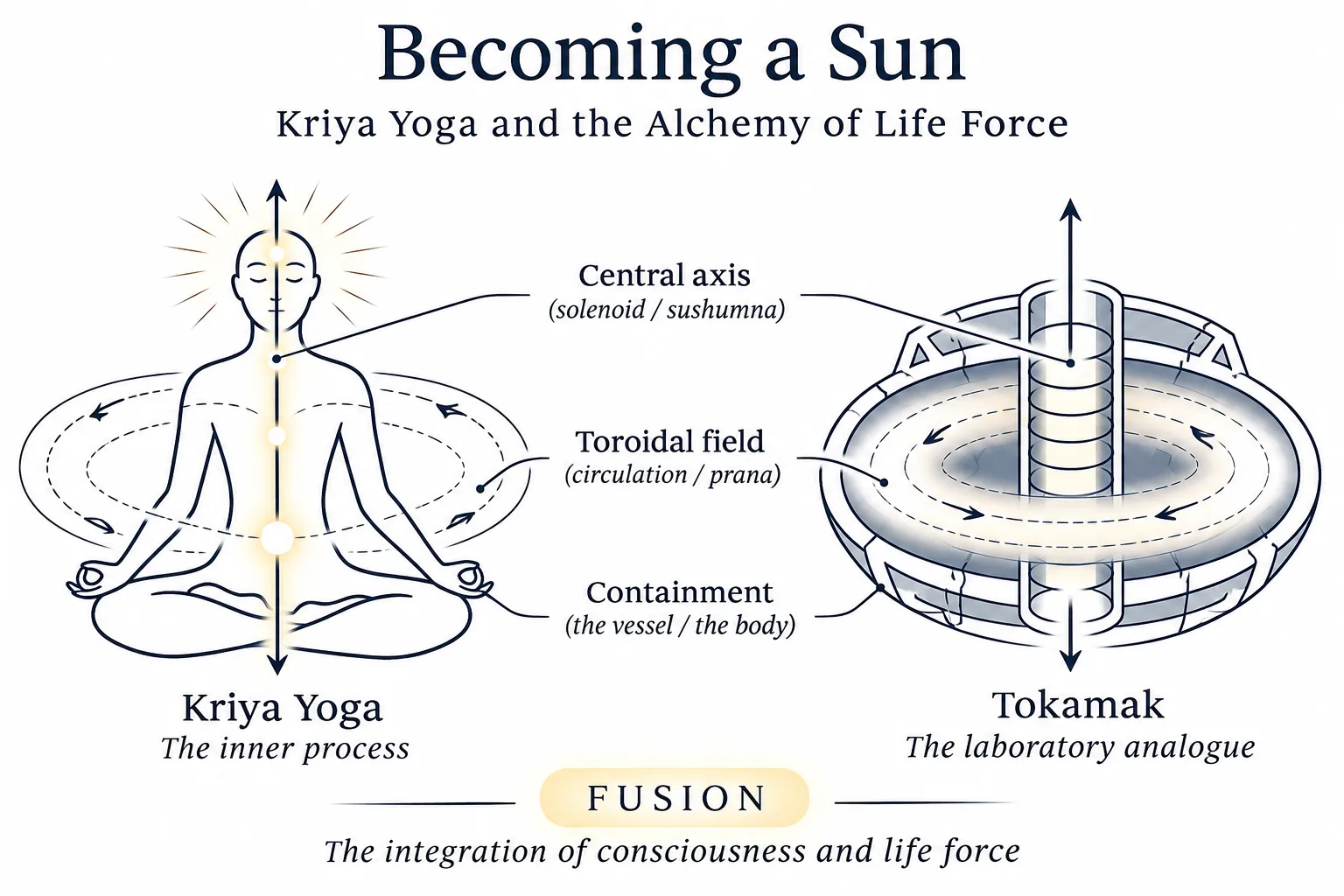
What fascinated me was the relationship between the central axis, the circulating field, the containment of tremendous energy, and the possibility of fusion.
It reminded me of Kriya Yoga, particularly Tritabandha and the circulation of prana and Kundalini Shakti through Sushumna Nadi, the subtle central channel associated with the spinal cord.
The parallels are fascinating. In the tokamak, the central axis and surrounding magnetic fields create the conditions for the circulation and containment of plasma. In Kriya Yoga, Sushumna Nadi provides a central axis around which the movement of prana and Kundalini Shakti can be understood. The relationship between the central channel, the circulation of vital force, and the containment of energy within the body reminds me of the toroidal structure of the tokamak.
For me, Tritabandha brings this relationship into particularly sharp focus. Through the integration of expansive consciousness and embodied awareness, I experience something resembling fusion — an alchemical process in which these dimensions come together as a more coherent sense of identity. The entire process of Kriya Yoga participates in this integration, with Tritabandha being one particularly tangible expression of it.
I am not claiming that atomic fusion has been demonstrated in the human body during meditation. But I am interested in the possibility that the analogy reveals something meaningful about the relationship between energy, containment, coherence, and transformation.
Perhaps the central question is not simply how much energy we possess, but how we relate to it.
Becoming a sun
A star is an extraordinary expression of the relationship between energy and containment.
Within a star, gravity creates the conditions under which nuclear fusion can occur. The outward pressure generated by the star’s hot interior is balanced by the inward pull of gravity.
The star becomes a sustained source of radiation and warmth.
I find this a powerful image for spiritual development.
What if the purpose of Kriya Yoga is not simply to achieve a state called enlightenment, but to cultivate the conditions in which consciousness and embodied vitality become integrated?
What if the human being can become, in an experiential sense, a sun?
Not someone who needs to acquire energy from the world to establish an identity, but someone increasingly capable of experiencing and expressing the vitality of life.
This doesn’t mean becoming self-sufficient or no longer needing relationships. A sun is itself part of a larger cosmos, participating in relationships and processes far beyond itself.
Similarly, the individual remains embedded in family, community, nature, and the larger field of life.
Perhaps becoming a sun means becoming a more conscious participant in that field.
An alchemy of identity
There is another dimension to this that I find particularly important.
We often approach spiritual practice as though there is an ordinary self that must eventually be replaced by a spiritual self.
But my experience suggests something different.
The embodied self does not need to disappear, nor does expansive consciousness need to remain an experience separate from everyday life.
Through practice, these dimensions can become increasingly integrated.
This is why I think of Kriya Yoga as an alchemical process.
Alchemy is not simply the movement from something inferior to something superior. It is also the bringing together of elements that, through their relationship, give rise to something new.
In my experience, the movement between stillness and embodiment gradually changes the felt sense of who I am.
There is less of a division between the person who is meditating and the person who is living.
The practice becomes life, and life becomes practice.
Life force, awareness, and the creation of new pathways
Returning to the question of desire, I wonder whether one of the most significant effects of spiritual practice is an expansion of our awareness of life force.
When awareness is limited, we may recognize vitality primarily through its most familiar expressions: sexual desire, ambition, excitement, or the need for activity.
As awareness develops, we may discover a much broader spectrum of experience, including stillness, presence, intimacy, and creativity.
But awareness alone is not enough.
We also have to create new pathways through which life force can find expression.
This requires imagination, experimentation, and action. We have to become conscious of the habitual channels through which our vitality flows and begin exploring possibilities that may not yet exist in our lives.
Much of our energy is organized around familiar activities such as work, sexuality, achievement, and the fulfilment of responsibilities. These are important expressions of life, but they need not exhaust its possibilities.
The challenge is to discover what else might become possible.
Perhaps there is a creative impulse that has never been given form, a new way of relating to others, a different relationship with nature, or a contribution to the world that we have not yet imagined.
Recognizing these possibilities is only the beginning. We have to make room for them, cultivate them, and sometimes reorganize our lives so that they can emerge.
This is not necessarily easy. Familiar pathways are well established, and the movement towards something new may involve uncertainty and discomfort.
Yet perhaps this is part of spiritual practice itself: developing both the awareness to recognize life force and the capacity to give it new forms of expression.
The body is not an obstacle to this process. It is the vessel in which the process takes place.
A living sun
I am approaching my fiftieth year, and I find myself increasingly interested in this relationship between vitality, awareness, and embodiment.
Rather than seeing midlife simply as a period of decline, I wonder whether it can become a period of deeper integration.
A time when the energy previously invested in establishing an identity becomes available for a different relationship with life.
Perhaps this is one way of understanding the alchemy of Kriya Yoga.
The practice cultivates our capacity to contain and integrate life force, while awareness and imagination open new pathways for its expression.
To become a sun is to become a living vessel of life force — fully embodied, deeply aware, and increasingly capable of radiating that vitality into the world.
Perhaps that is what enlightenment might mean to me.